

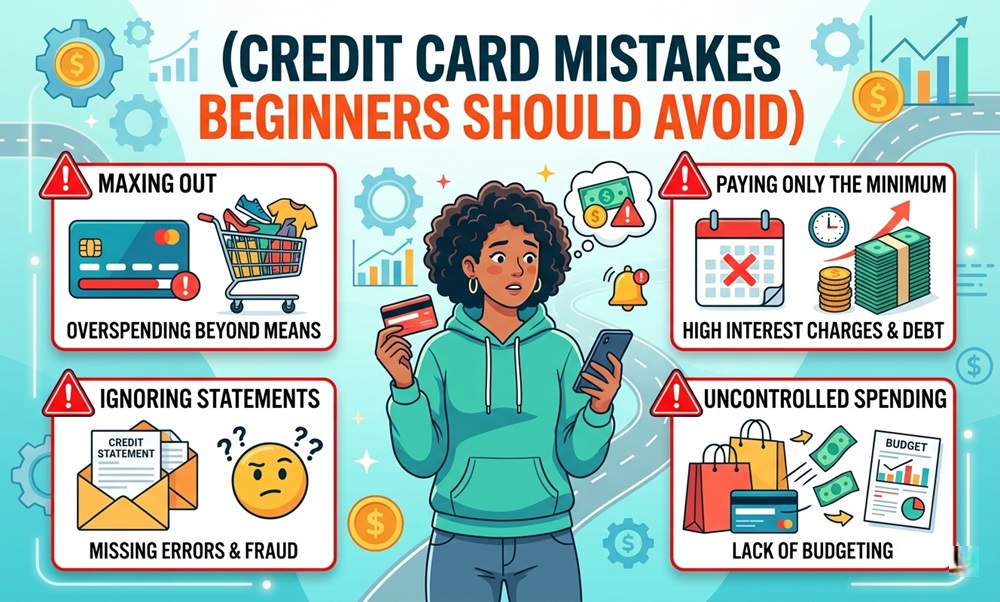
Getting your first credit card feels like a financial milestone — and it is. But it’s also where a lot of people quietly start digging a financial hole. The mistakes are common, the consequences linger, and most of them are completely avoidable once you know what to watch for.
Here are the credit card mistakes that trip up beginners most often.
Mistake 1: Only Paying the Minimum
This is the most expensive mistake you can make. When you pay only the minimum, the remaining balance accumulates interest — often at 20–29% APR. A $1,000 balance at 24% APR, paid at only the minimum each month, can take years to pay off and cost hundreds in interest.
What to do instead: Pay your full statement balance every month. If you can’t afford to pay it all, pay as much as possible above the minimum.
Mistake 2: Missing a Payment
A single payment more than 30 days late gets reported to credit bureaus. One missed payment can drop your credit score by 60 to 110 points — and it stays on your report for seven years.
What to do instead: Set up autopay for at least the minimum payment. Then manually pay the rest. This way, you never accidentally miss a due date.
Mistake 3: Maxing Out Your Card
High credit utilization — the ratio of your balance to your limit — is one of the biggest score killers. Going above 30% starts hurting you. Going above 70% hurts significantly.
Example: If your limit is $500, try to keep your balance under $150.
What to do instead: Keep utilization below 30%. Ideally, aim for under 10% if you’re actively building credit.
Mistake 4: Applying for Multiple Cards at Once
Each credit application triggers a hard inquiry on your credit report. Multiple inquiries in a short window signal risk to lenders and can drop your score by several points each.
What to do instead: Research thoroughly, choose one card, apply once. Wait at least 6 months before applying for another.
Mistake 5: Closing Old Accounts
It feels tidy to close a card you don’t use. But closing accounts reduces your total available credit and shortens your average account age — both of which hurt your score.
What to do instead: Keep old accounts open. Make a small purchase once every few months and pay it off immediately to keep the account active.
Mistake 6: Ignoring Your Statement
Many beginners set up autopay and never look at their statement again. This is how fraudulent charges go unnoticed — sometimes for months.
What to do instead: Review your statement every month. Many apps alert you to unusual activity, but manual review takes 5 minutes and is worth it.
Mistake 7: Using Cards for Every Purchase Without Tracking
Credit cards make spending feel abstract. It’s easy to forget you’ve spent $600 when you haven’t handed over physical cash.
What to do instead: Check your balance weekly. Many issuers have apps that categorize your spending — use them.
Common Mistakes at a Glance
| Mistake | Consequence | Fix |
|---|---|---|
| Minimum payments only | Debt spirals, interest costs | Pay full balance monthly |
| Missing payments | Score drops 60–110 points | Set up autopay |
| High utilization | Score damage | Stay under 30% |
| Multiple applications | Multiple hard inquiries | Apply for one card at a time |
| Closing old accounts | Shorter credit history | Keep them open |
Expert Insight
The single habit that separates people who thrive with credit cards from those who struggle is treating the card like a debit card. Spend only what you have in your bank account, pay the full balance monthly, and the card becomes a tool that builds credit and earns rewards — not a debt machine.
FAQs
Q: How much does a late payment hurt my score? A 30-day late payment can reduce your score by 60–110 points depending on your current score and history.
Q: Is it bad to have a zero balance on my credit card? No — carrying a zero balance is fine. But having some small activity (1–5% utilization) and paying it off shows positive account usage.
Q: Should beginners get a rewards card? Only if you’ll pay the balance in full each month. If there’s any chance you’ll carry a balance, avoid rewards cards — their higher APRs offset any points earned.
Q: How quickly can I recover from a credit card mistake? Missed payments take 7 years to fall off your report, but their impact on your score fades significantly after 2 years of good behavior.
Q: What’s the safest credit card habit to start with? One card. One recurring small charge. Full payment every month. That’s it.
Conclusion
Most credit card mistakes aren’t dramatic — they’re small habits that compound over time. The good news is that the fix is simple: pay in full, pay on time, and keep balances low. Start those habits now, and your credit profile will be genuinely strong within a year. The credit card isn’t the problem — how you use it is.